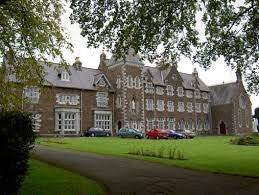
Aware of the extreme distress of his parishioners Fr. Denis Collins, Parish Priest of Mallow, with the approval of Dr. Crotty, Bishop of Cloyne, applied for a foundation of Sisters of Mercy in Mallow parish to Mother Elizabeth Moore of Limerick in 1845. She acceded to his request and 13 October 1845 she set out for Mallow with 7 Sisters.
The Sisters who came to Mallow were:
Sr. Mary Baptist Purcell
Sr. Mary de Chantal Maher
Sr Mary Agnes Maher, who were sisters.
Sr. Mary Joseph Farrell
Sr. Mary Aloysius Dwyer
Sr. Mary Veronica
Sr Mary Xavier Creagh.
The house which had been rented for the pioneer group of Sisters was beside the Parish Church.
It is a fine substantial comfortable building today but the Mallow Annals tell us that in 1845, “It was dark and cold”. The Sisters had to use a blessed candle in the growing darkness. The fire was bad and a few sticks had to be collected in the adjacent Church yard to make a good one”.
The Sisters were to spend five years in this house which was named St. Patrick’s. From there they set out on their ministry. Catherine McAuley believed that the best way to help and empower the poor was to provide education which would give them self-respect and a sense of dignity and self-worth. There was a parochial school situated in the present Chapel Lane where the help of the Sisters was welcomed in the understaffed school of 700 pupils. The Sisters also catered for a small group of older pupils in the convent building.
The Famine fever was particularly severe in Mallow and the Sisters began visiting homes where, “they helped to care for the poor sufferers and to comfort the grief-stricken relatives”. (Annals).
In June 1847 one of these nursing Sisters contracted the disease herself and died on 25 June 1847. She was buried in the Churchyard where her grave “was marked by a small wooden cross”. (Annals).
By now three of the original pioneer group had returned to Limerick so the remaining three were happy to welcome two postulants in June 1847 – Catherine Buckley from Doon, Co. Limerick and Susan Creagh from Springmount, Mallow. In 1849 they were joined by a third young woman, a Miss Bodleim.
As numbers were growing and enquiries were being made by other women it was becoming apparent that the house in Bank Place was inadequate for the needs of the Sisters. Moreover, as they were becoming more aware of local needs they and the parish priest had hopes of setting up a school in another part of the town, and of establishing a Home for Children orphaned by the Famine. All of these ventures would require more space. Once again the Mallow priests came to the rescue. Fr. Collins P.P. had succumbed to the Famine Fever in 1848 and his successor as parish priest was the former curate Fr. Justin McCarthy. Fr. Justin had acquired lands at Bathview, Mallow, and had built a presbytery for himself and his brother, Fr. John McCarthy. This building he decided to hand over to the Sisters and it was to become the nucleus of the large convent which developed over the years.
Move to Bathview
On 1850 the Sisters left St. Patrick’s, Bank Place and took up residence at Bathview. Local limestone and old red sandstone helped to make the facade of the new house externally very impressive. Internally, however it was barely adequate even for the small number of Sisters as it extended left from the front door just the width of the three small rooms.
Almost immediately a school was planned and a two-storey building was erected which was to be the Convent Primary School from 1850 to 1910 and which subsequently became the original St. Mary’s Secondary School in 1932.
St. Joseph’s Orphanage, Residential Home
Around the same time, 1850 – 51, St. Joseph’s Orphanage, Residential Home for Children-in-care was built and soon there were 30 children in residence. These buildings had taken some time in construction and the exact date of their opening is not recorded but we do know that the land around them was acquired during the first decade.
The Annals recorded that the Orphanage was built, “At the expense of the community without local assistance,” However, maintenance had to be, “Financed with difficulty by the help of private gifts from priests, and from the friends of the community, together with sales of work, collection cards and responses to charity sermons.”
St. Joseph’s Home for Children had been officially inspected over a number of years and in 1880 it was officially certified by the Right Honourable James Lawlor, Chief Secretary to the Lord Lieutenant of Ireland, John Lentaigne Esq. As a result, State aid was made available. The number of places for children was increased to 60. This necessitated the addition of extensions to the original building which was undertaken immediately. It is interesting to note that “Mr. James Allen, who was in charge of the construction, undertook under penalty of £50, to execute all the specified work within the period of four months from 1st May 1880”. It was finished on time!
Development and Consolidation
In the meantime there was also an increase in the number of Sisters in the convent. By the Silver Jubilee of the Foundation in 1870 nineteen Sisters had joined the original group. By the Golden Jubilee in 1895, 65 Sisters had joined. These extensions went on over a number of years and can be summed up in a single entry “Growing needs called for continuing planning to extend accommodation for the Sisters”. (Annals 1892)
Obviously, money was required for all of these enterprises. This was made possible through the generosity of a benefactor.
1870 – 1900
The next decades were a time of growth and consolidation. The numbers of pupils and teachers in the convent Primary School increased indicating even by the 1880s that extensions or replacement should be planned for. At first, the Sisters had to suffer restrictions regarding Religious Instruction and Prayer during class hours imposed by the National School Board. Religious pictures and statues could not be exposed except during the half-hour allowed for official religion class. Eventually, however, these restrictions were modified. This probably happened as a result of the decision of the Sisters to have the school incorporated in the new structure of The National School Board in 1869.
New Primary School Building 1910
Developing events in the early part of the twentieth century forced the community to re-focus on the ministry of education. It had been recognised for some years that the 1850 school building was inadequate for the steadily growing number of pupils and that a new primary school building was urgently needed. Two sets of lengthy negotiations had to be engaged in before the actual building of the school. From June 1898 there were local discussions about the acquisition of one statute acre for the site – the lease, or sale, clarification of title deeds; the concreting of the play-area. Negotiations with the Department of Education was equally long-drawn out. A lengthy correspondence dragged on until final permission was granted in 1908. The event was doubtlessly precipitated by the fact that one of the Sisters had inherited a large sum of money from American relatives and so the community would be able to be responsible for the “local contribution”. Work on the new building began immediately. It was completed by 1910, or in 1911 the delay being caused by the disagreement about concreting the playground. This 1910 school building continues to be the nucleus of the present Convent Primary School while new extensions have been added over the years. Our Annals record, “In the main, few substantial repairs in the building itself have been called for.”
St. Mary’s Secondary School
As early as 1903 there is reference to the awareness of an urgent need for a secondary school for girls in Mallow. Not until 1932, however, was it found possible for the Sisters to satisfy this so-obvious need. Early in 1932 the old 1850 Primary School building, vacated since 1911, was prepared and fitted for the accommodation of the group of Primary School-leavers anxious to continue their education. When the new school year began on 29 August 1932 St. Mary’s Secondary School came into being. There were two teachers, a young newly-professed Sister and one young lady lay-teacher to cater for the 28 students enrolled that first day.
The story of the school in the next decade is a story of gradual growth, of much development and of many academic successes. The original two-storey building had to be re-constructed to accommodate growing numbers. Extensions were added several times, the first one attached to the main building and further new blocks of class-rooms in the field in front of the convent. Finally in 2003, a completely new school was opened for 600+ pupils.
Post 1930 Developments
The next few decades marked another period of consolidation and development of existing ministries. We have records of on-going growth of pupil numbers in both Primary and Secondary Schools which necessitated the building of extensions and eventually to the establishment of a completely new Secondary School.
Scoil Iosagáin
By the 1960s it was evident that the Infants’ Department would benefit by being separated from the main Primary School. Numbers in the Infants’ classes (called “Low”, “Middle” and “High”) reached eighty and even ninety children per single class. There weren’t any rooms available for divided classes so a separate building was planned.
In 1964 Scoil Iosagáin was opened as a separate establishment on its own grounds and with its own entrance from the Spa Glen. It catered for young girls and also welcomed their young brothers in four airy class-rooms with extra teachers in a family-friendly environment.
New developments in education at primary school level were studied adapted and adopted as the years went on! Shared area facilities, resource education, literacy programmes, remedial education, all were analysed, evaluated and used or discarded as the planners endeavoured to make education more practical and more pupil-friendly, without departing from traditional high-standards. More attention was given to Music, Drama, Art, P.E., Science, Pastoral Care and Care of the environment.
An important development was the establishment of St. Oliver’s Special Classes. In the late seventies the Friends and Parents of Children with Special needs set up St. Oliver’s Special Classes in the Old School. Eventually, St. Oliver’s became a Special unit attached to the Convent Primary School (1983). Later a Secondary School branch of St. Oliver’s was opened at St. Mary’s Secondary School.
While discussions continue about the relative benefits of “integrated” and “special” education, very special education by very special dedicated teachers continues at St. Oliver’s, both at primary and secondary level.
At Post-Primary level, the introduction of Transition Year Programme, the Applied Leaving Certificate Course and the Post Leaving Certificate Course, have enriched and broadened the whole concept of education at senior level. They have provided welcome new opportunities to our senior students and school leavers for intellectual and personal development, as well as for practical and new openings for career options.
(i) Foundation in Kanturk 1868
Sometime in the mid-sixties a request came from Archdeacon O’Regan (with the approval of Dr. Keane, Bishop of Cloyne) for a foundation of a Mercy convent in neighbouring Kanturk. On 8 December 1868, six Sisters left Mallow for Kanturk where a newly-built convent furnished, and attached to the Parish Church, had been prepared for them. They were accorded a royal welcome by the people of Kanturk. They took charge of the existing school and soon opened a “select day school” for older girls. This latter school eventually developed into a flourishing secondary school.
Visitation of the sick and house-bound was also undertaken.
Kanturk convent remained a “branch-house” of Mallow until diocesan amalgamation in 1916 when it became an independent community. Until 1916 there had been ongoing inter-change of Sisters between the two houses and a special friendship continues to exist between the two communities.
(ii) Foundation in Blarney 1882
A letter from Bishop McCarthy dated 12 October 1882 introduced the subject of a prospective foundation in Blarney. The Bishop (Fr. John McCarthy for C.C. of Mallow) explains that the O’Mahony family of Blarney Woollen Mills wished to establish a community of Sisters in the area. On 21 November 1882 four Sisters left Mallow for Blarney where a “pretty cottage” had been prepared for them and a “small Infants’ School” had already been built. Immediately work began in the school and evening classes for factory girls were planned as well as “a class for Instruction on Religion” at an arranged time on Sunday.
(iii) Fermoy Workhouse 1889
A letter form Bishop McCarthy dated 10 January 1888 informs the community in Mallow that he had received a formal request from the Guardians of Fermoy Workhouse to establish a convent and to take charge of the Workhouse and its school in Fermoy.
Some Sisters had already done some nursing training in Cork and had some nursing experience in Youghal and Midleton. So the invitation was accepted and in 1889 six Sisters left for Fermoy; four of these were to work in nursing and in administration while two were to teach in the Workhouse School.
However, three years later, a difficult decision had to be faced…..There was a request from the Governors of Kanturk Workhouse for two or three Sisters to do “nursing duties” in the Workhouse. There is extensive correspondence on the subject the upshot of which was that sisters would be made available for Kanturk. However, it was evident that the Mallow community could not provide for both Fermoy and Kanturk. As Kanturk convent was already well-established, and even more importantly as it was our branch-house and therefore our responsibility, it was decided to withdraw the Sisters from Fermoy and to continue to develop the Kanturk foundation. The Mercy Sisters were sad to leave their charges in Fermoy but were happy that it had been arranged that they would be replaced by members of the Little Company of Mary (the Blue Sisters) from Limerick.
Amalgamation of Mercy convents in Cloyne 1916
In the meantime another event occurred which had far-reading implications for the Mallow community and for each Mercy community in the diocese of Cloyne. Amalgamation of the Mercy Convents in Cloyne had been discussed for some time and it became a reality in 1916.
A new structure of leadership was organised and set up at a Genevalate in Cobh where in future important decisions about developments and ministry would be made. A General Novitiate was established at Bella-Vista, Cobh where subsequent novices would receive their initial training. Three novices from Mallow community, half-way through their own training joined the new group at Bella-Vista. Kanturk ceased being a Branch House and became an independent convent.
Generally, the changes were beneficial and welcome: horizons were broadened, life-long friendships formed at Bella-Vista, closer relations with other communities developed Corporate ministries which would have been difficult, or even impossible for a single community became possible and individual Sisters from Mallow became involved in ministries and enterprises in St. Coleman’s College, Fermoy, in Rayleigh, diocese of Brentwood, England, and in the Cloyne Mercy Mission to the diocese of Eldoret, Kenya. Individual Sisters were also transferred to other communities as needs in administration, or, in ministry demanded.
Holy Spirit Convent 1930
In March 1928 Canon Corbett, P.P. of Mallow consulted with the Bishop and with the Sisters about a new enterprise. The Canon was conscious of, and very concerned about the suffering and helplessness of many sick, poor and elderly people in these pre-Public Health days. He shared his dream of setting up a small foundation of Nursing Sisters who would offer care, companionship, a listening ear as well as professional nursing services to these people. For this purpose he was willing to build a small convent, at parish expense beside St. Mary’s Parish Church if Sisters from the Mercy convent were available to minister there.
The dream became a reality in August 1930. Four sisters “moved down” to Holy Spirit Convent on the Feast of the Assumption, 15 August 1930.
The Nursing Sisters had a special out-patients department and also conducted a home-nursing service in the town and in the immediate neighbourhood. Eventually, as Public Health services became available the nature and scope of their work changed.
It is acknowledged that Holy Spirit Convent has truly fulfilled the prophecy of Bishop Brown in a communication of 1928.
“The people of Mallow will be delighted when they come to know of this undertaking. It is a noble enterprise which when realised will perpetuate the memory of Canon Corbett as the friend and benefactor of the Poor”.
Other developments in ministry
ANCHOR, a non-residential treatment centre for people in addiction was set up in 1995 in what was originally the gardener’s bungalow on the Convent grounds.
Another direct result of the perception of new needs in a New Ireland was the Sisters’ involvement with a large new housing estate on the outskirts of the town and the setting up of Woodview Drive Resource Centre (opened in 1996).
Another development initiated by the Mercy Sisters was the building of the MERCY CENTRE in 1994 in the Front Field. Here a large hall and several smaller rooms provide accommodation in congenial surroundings for meetings of people involved in pastoral, spiritual, parish and support groups.
Meadow Grove Sheltered Accommodation
As far back as the nineteen eighties the local leaders of the St. Vincent de Paul Society asked for help in setting up sheltered homes in Mallow. Eventually, in 1994 three Sisters moved into a small Mercy Convent in Summerhill to helpwith the initial foundation and management and set it on a firm footing before it was handed over to the S.H.B. in 2004. The Sisters remained on in a pastoral capacity until 2010.
(Adapted from an article by Sr. Margaret O’Brien in 2008)
Sources
Annals of the Convent of Mercy, Mallow.
Annals of the Convent of Mercy, Limerick. A history of Mallow by Evelyn Bolster.
Register of the Convent of Our Lady of Mercy, Mallow.
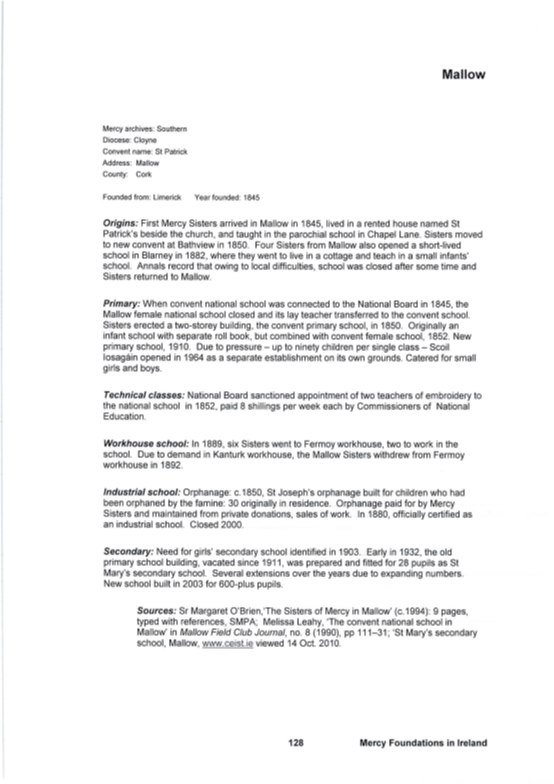
From :The Contribution of the Congregation of the Sisters of Mercy to Education.
Vol 11. Dr. Máire Ní Chearbhaill, Research Fellow. NUI Maynooth. July 2011
 Southern Province