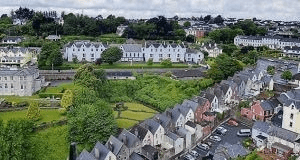
The name of the town of Cobh can be confusing. Originally it was known as Cove. In 1849, Queen Victoria first came to Ireland. To commemorate the occasion, the town was renamed Queenstown. In 1920, the town reverted to its original name, using the Irish spelling, Cobh.
In 1845 when Patrick Joseph O’Connor of Clifton Cottage, Cove rented plots on Spy Hill, from James Hugh Smith Barry nobody could have foreseen how that transaction would become part of the history of the Sisters of Mercy in Ireland. Patrick built a dwelling house on each plot, collectively known as Belvedere Terrace. Subsequently, he built a second house on the first plot which was known as “The Lodge.” In 1847 numbers1, 2 and 3 were sold to William Moore Drew of Beechmount for 1,680 sterling and No 4 to Samia and Lucy Woods of “The Priory” for 900 sterling.
In April 1850 the parish priest of Queenstown, Rev Timothy Murphy, on behalf of the Bishop of Cloyne, Rev. Timothy F. Murphy, who resided in Fermoy, bought numbers 1, 2 and 3 plus the Lodge for 2,800 sterling to be held in trust, “For the purpose of founding and establishing at Queenstown a branch of a certain religious society, community or establishment of females professing the Roman Catholic Religion and called and known by the name of the Sisters of the Order of Mercy.” (Deeds of the House.)
Bishop T.F. Murphy, having acquired a house, lost no time in applying to Rev. Mother M. Joseph Warde of the Sisters of Mercy in Rutland Street, Cork for a foundation of Sisters of Our Lady of Mercy for Cove. The following is the entry as found in the Annals of St. Maries of the Isle re the Queenstown Foundation
May 23rd The Bishop of Cloyne, Right Rev. Dr. Murphy,applied applied to Rev. Mother Joseph Warde for Sisters to come to found a Convent in Cobh. The permission and approbation of Dr. Delaney, Bishop of Cork, having been obtained, a spacious house and garden, also the funds necessary for the maintenance of the Sisters were secured, and preparations made as soon as possible. The Sisters chosen for the foundation were Mother Mary Josephine McCarthy, who had been Mistress of Novices in the Cork Convent, Sister Mary Baptist O’Neill, Sister Mary Teresa Carroll, (a Novice) , and Sister Teresa Down. Mother Mary Joseph McCarthy was appointed the Mother Superior. Rev. Mother Mary Joseph Warde went with them to Queenstown. After some weeks she was able to return to the Convent in Cork.
Shortly after the arrival of the Sisters in Queenstown, postulants entered; the works of the Institute were commenced and the schools, especially, became very flourishing. The hoped for good results were fully realised.”
The Sisters took up residence in numbers 1 and 2 of Belvidere Terrace. The Lodge was rented to the parish priest. No 3 was rented to a Protestant clergyman, Rev Samuel Harman.
Within a year of their arrival the Sisters had a new national school erected in the garden of No 2 from the proceeds given to them. There were two rooms, one on top of the other. The pupils were girls and admission was gratuitous. The school was affiliated to the National Board of Education in 1851 and there was a grant of 10 pounds for every 100 children. Later a capitation grant was paid on average daily attendance. Senior girls acted as monitoresses working in groups of 12-20 until there were enough teachers trained. Boys came around 1871 and transferred to the Boys’ National School after their First Communion. This original national school was extended in 1866 to accommodate an Industrial Department. It cost 650 pounds and was paid for by public subscription. The programme comprised of needlework, shirt making, underclothing, cutting out and knitting. There were 18 adults working an 8 hour day there and 175 children working one hour. The adults paid 2/- to 4/6 per week and the pupils one penny. The adult work was sold by the Sisters to shops and private families with the cost of the material deducted. In 1891 the school was enlarged further. A new building was erected in No 4 at a cost of 250 pounds to accommodate a weaving school under the 6th class Industrial Programme. It contained 10 looms for weaving linens and lawns and two for towelling. Mr Halliday from Belfast taught the weaving in Queenstown and Skibbereen. In 1897 a further development of the Industrial Department was provided for ongoing training for employment. A lace room was added and training was given in Mountmellick work, English point lace and Carrickmacross lace which was sold at home and abroad and was brought out to the liners visiting the harbour and sold to the passengers. In 1901 the average number of girls employed was 48. The lace making was abandoned after the First World War (1914-1916).
A new school was built and opened 20 August 1916, despite the war difficulties. It was called St Mary’s National School. In 1974 an eight-room extension and a P.E. Hall were added. Over the years further extensions and improved facilities were added. The school now has a Learning Support Room and a fully-equipped Information Technology Room. The Principal, leads a staff of fourteen class teachers and four Learning Support/Resource Teachers. The school also has a full-time caretaker and secretary, who together with classroom assistants, a traffic warden and the cleaning staff ensure that everything runs as smoothly as possible for the more than 350 pupils who attend each day. The Sisters of Mercy no longer work there.
The Pension school: From the beginning in 1850 there was a private pay school (also called pension school) on part of the convent premises. When house, number four became vacant it was taken over by the convent and a pay school was located in that building. There were separate sections for boys and girls as the need arose e.g. in 1884 fees of 40 pounds were received from the Boys Pension school and 140 pounds from the Girls Pension school. The curriculum was the same as that of the National School but a foreign language was also taught – French, German or Italian. When the senior section of this Pay School was registered as a separate Intermediate School the junior section continued to run as a Private Fee Paying School. The new National School opened in 1916 and the vacated Industrial Room was occupied by the Junior School from that time. Both schools had the same Principal and the same uniform. As the numbers increased an additional room was added in 1932. In 1968 the phasing out of the junior school commenced and soon all went to the new National School.
St Mary’s Secondary School: Advanced education for females was provided in the Pay School until the Intermediate Act was passed in 1878. Older girls from the area went to boarding schools in other parts of the country. St Mary’s Secondary School grew out of the Senior Section of the Pension school some time before 1891. Fees were paid on the basis of results. In 1903 a Science room was fitted out in the old weaving room of the National School. Around this time a cookery room was fitted out in Belvedere Lodge, now known as The Flat. Sisters did summer courses in science, cookery, maths and drawing. By 1907 there were 28 pupils on roll and Queenstown is listed as one of the schools which participated in the Preparatory Grade Prize Fund. In 1911 the school received a special music bonus for a choir. There were cookery classes at night for the adult ladies of the town 1906-1917 given by Sr Madeline.
There was a public lending library behind No 4 under the direction of Mother Brigid Finnucane who linked with Cork City Library. This also served as an excellent school library.
The first Sister to have a University degree was Sr Paschal Maguire who had her degree before she entered. Then in 1931 Sr Eithne Hogan was sent to UCC. From this time onwards it was necessary to have a University education to teach in the secondary school. Numbers increased in the secondary school from 52 in 1925 to 168 in 1959. Following free education in 1967 and lengthy discussions, the Presentation Brothers College, and St Mary’s Secondary school amalgamated from 1976. A new co-education voluntary secondary school opened in 1981. For twenty years the principalship was held by a Mercy Sisters from 1985 until her retirement in 2005. Over the years many changes and developments followed including the Millennium Stadium which opened in 2001,comprising of a full size Astroturf pitch, a full size GAA / Soccer pitch, two tennis courts and a running track. The Sisters of Mercy are no longer actively involved but their vision lives on in Cobh.
Amalgamation and Novitiate: In 1916 The Mercy Sisters in the Cloyne diocesan amalgamated. A house near the convent called Bellavista became the Generalate and Novitiate for the diocese. Novices came there from Kanturk, Macroom, Buttevant and Charleville. Bellavista served as a Novitiate for 14 years until 1930.
Mount St. Mary’s: In March 1922 the last representative of the British Government, Vice Admiral Sir Ernest F. A. Gaunt, left Admiralty House Cobh. Admiralty House was burned down (by Sinn Fein irregulars) on 8 August 1922. In 1930 the Sisters of Mercy bought the house and transferred the Novitiate and Generalate to Admiralty House. The name was changed to Mount St. Mary’s. (The Mount). In 1990 the Sisters of Mercy left the Mount. In response to the invitation of Bishop John Magee of Cloyne in 1993, the Benedictine Sisters of Tyburn moved to Cobh to provide a Benedictine, contemplative presence in the diocese. It is now called St. Benedict’s Priory, Cobh.
Norwood/Rushbrooke: There was a small school there from the 1870s erected by a benevolent gentleman, Nicholas Murphy who owned the property. Two Sisters travelled out each day to teach there. In 1874 Mother Baptist O’Neill negotiated the purchase of his property but it was given free on condition that it would be a branch convent and a supplemental orphanage. Mr Murphy paid 300 pounds for the necessary alterations. From the 1870s about 10 Sisters lived there. By 1880 there were 21 boys and 61 girls in a very small building. In 1885 steps were taken to provide a larger school which was registered on 23 July 1889. Numbers continued to grow until the 1950s and in 1959 the whole building was reconstructed. Further expansion took place in 1961 when the children from the orphanage in Cobh transferred to Rushbrooke, and also, families had moved there when the Verolme Cork Dockyard expanded and a new housing estate was built. The final extension was added in 1980. Mr. Rushbrooke travelled back from Africa to transfer 5 acres of land to the Sisters, who in turn donated them to the parish for the new extension. Rushbrooke became a totally separate convent in 1983. (See separate account of Rushbrooke)
St. Colman’s Industrial School/Orphanage: For twenty years orphans, were cared for in the convent. In 1854 Rev. Mother Josephine McCarthy was left £200 to be used for the care of orphans. The Industrial Schools Act was passed in 1868 and as a result orphanages began to be built throughout the country. Around this time the Sisters purchased the third house in Belvedere Terrace for more than £2,000. The orphans were transferred there. When it certified under the Act on the 5th September 1870 it was designated St. Colman’s Orphanage. It was for both boys and girls until 1874 when the boys were transferred to the orphanage in Greenmount, Cork. The decision was taken in 1961 to transfer the children from St Colman’s Cobh to the Sacred Heart School, Rushbrooke. The new residence in Rushbrooke was situated in its own grounds with a well wooded background it provided a splendid well equipped residence for the children. The majority of the children attended the Primary School attached to Rushbrooke convent, and the older girls attended St Mary’s Secondary school in Cobh as in former years. (See Rushbrooke)
House of Mercy: There is very little information on this and no mention of the section of the building used. The Cork Examiner of August 15, 1850 mentions that a Charity Sermon would be preached by a Rev R O’Brien in aid of funds for the House of Mercy, Queenstown. The 1851 Census of Population for Queenstown lists 495 female servants out of a total population of 4,654 i.e. 10% with 13% by adding rural areas. From 1852 reference is made in the accounts for money expended on orphans and servants. From 1874 a House of Mercy is specifically mentioned. Simultaneously there is mention of St Coleman’s Industrial school records with pupils going to the ‘Servants Asylum’ attached to the convent until a suitable situation occurred. Income for the support of these ‘destitute young women’ was provided by the fundraising efforts of the Sisters at an annual bazaar and occasional charity sermons. This apostolate was abandoned in the 1940s.
Foundations from Cobh: Macroom 1865 and Rushbrooke1874.
Closure of convent 2009: In recent years it had been become increasingly obvious that maintaining the old convent in Cobh was no longer a viable option. A long process of discernment and decision-making followed until it was decided that the closure date would be 23 May 2009, which, rather poignantly, marked the 159th anniversary of the coming of the Sisters of Mercy to Cobh. The Sisters relocated to other places. The convent was offered to the State and Department of Education but the offer was not accepted. The convent was put up for sale and the proceeds went towards the Government contribution to the Residential Institutional Redress Board.
Sources :
Research, Dr Liz Murphy, RSM June/July 2014
Mercy Live Ann Lenihan 29 September 2009 Annals St.Maries of the Isle
Orphanages Cobh & Rushbrooke ,Marcella Barry, RSM
 Southern Province